
Choose the Right Faucet by Project, Not Just by Brand
Nina Okonkwo
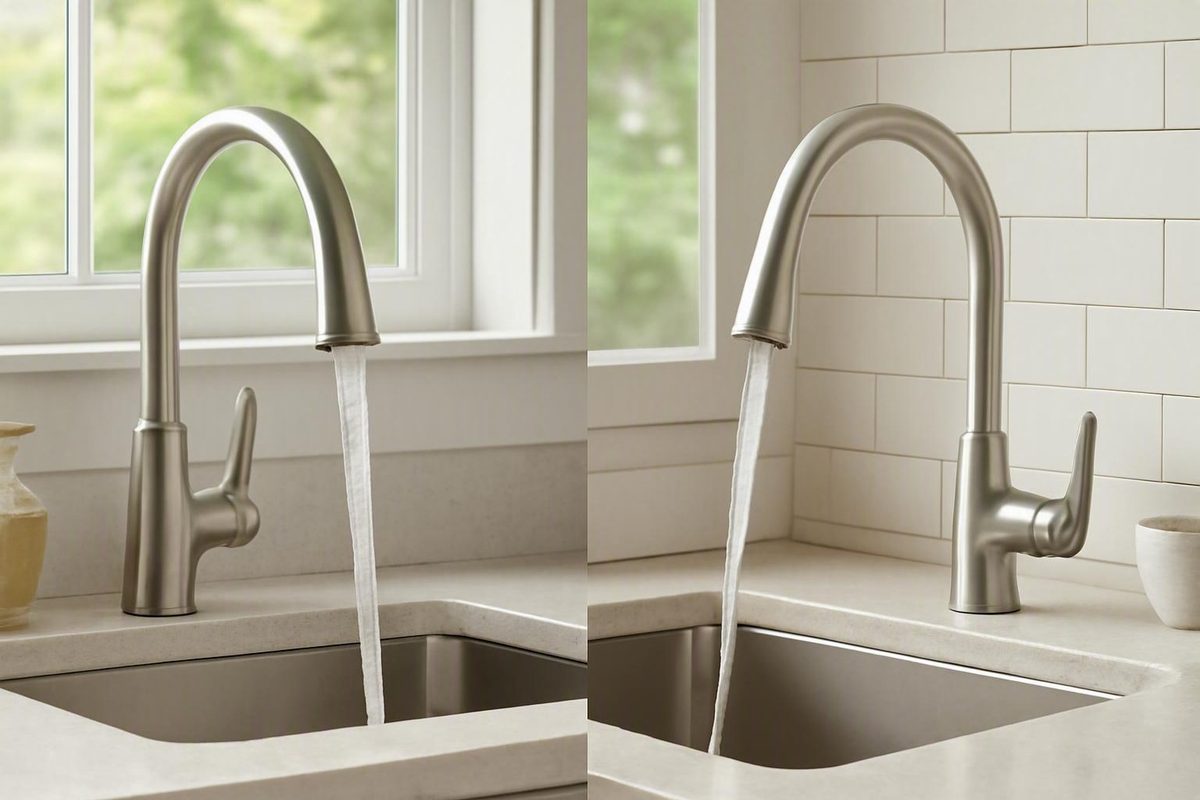
Choose the right faucet by project, not just by brand.
The short verdict: who should choose Moen and who should choose Kohler?
For a practical replacement, begin by comparing equivalent Moen models when budget discipline, familiar servicing, and locally available repair parts are your leading priorities. For a design-led kitchen or premium bathroom, give Kohler closer consideration when a particular silhouette, finish, or coordinated collection is central to the project.
That is a shortlist strategy—not proof that one brand is better. Commercial comparisons generally position Moen as a mainstream or mid-range choice and Kohler as extending further into premium, custom, and design-focused projects. The same comparisons emphasize that the correct choice depends on the product line and application rather than the logo alone (Banner Plumbing’s Kohler-versus-Moen comparison).
Kohler’s premium positioning does not establish that every Kohler faucet lasts longer. Moen’s reputation for familiar servicing does not establish that every Moen model is easier to install or repair. Both companies sell products across overlapping price and feature tiers, and an individual faucet can depart substantially from its brand’s general market position.
This guide is therefore a preliminary brand-positioning overview and model-selection framework, not a current model-by-model buying guide. The available evidence consists primarily of retailer, contractor, plumbing-business, and owner-forum commentary. It does not include current manufacturer specification sheets, installation manuals, parts diagrams, warranty documents, or equivalent-model tests across the full product ranges.
The scope is also limited. It primarily covers kitchen and bathroom faucets, with related compatibility considerations for shower valves and trim. The evidence does not justify extending the comparison to toilets, tubs, sinks, or every other product sold under the Kohler and Moen names.
| Priority | Moen | Kohler |
|---|---|---|
| Broad market position reported by comparison sources | Commonly characterized as mainstream to mid-range, with higher-feature options available | Commonly characterized as mid-range through premium, with a stronger luxury and design emphasis |
| Design emphasis | Broad practical, traditional, and contemporary coverage | Frequently associated with distinctive collections and premium finishes |
| Reported serviceability | Often described as familiar to service, but parts and procedures vary by model and location | Must be checked by exact model; broad brand comparisons do not establish inferior serviceability |
| Connected-feature emphasis reported by comparison sources | Hands-free operation and broader water-management features | Connected faucet and coordinated bathroom controls |
| Reason to start a shortlist | Straightforward replacement, controlled budget, or locally verified service parts | Particular design, finish, collection, or coordinated-room requirement |
| What must be verified | Fit, model number, included parts, power needs, warranty, and local parts stock | Fit, model number, valve compatibility, finish availability, power needs, warranty, and local parts stock |
A contractor-authored overview reflects the same broad split, positioning Moen around everyday practicality and Kohler around luxury styling. It is commercial commentary rather than controlled testing, so it supports a starting framework—not a quality ranking (Burrini and Sons’ fixture-brand comparison).
The defensible verdict is conditional:
- Start with Moen when practical replacement needs, budget control, and locally confirmed service parts lead the brief.
- Start with Kohler when a particular design collection, finish, or coordinated appearance is worth prioritizing.
- Choose neither by reputation alone. Compare equivalent models, verify compatibility, and calculate total installed cost before ordering.
Why the exact faucet model matters more than a brand-wide ranking
A brand name does not tell you enough about the product in the box. Both Moen and Kohler sell products at multiple price and feature levels. Comparing a mainstream Moen faucet with a premium Kohler faucet may reveal more about their respective tiers than about brand quality.
Begin by matching the product category and intended use:
- Kitchen faucet against kitchen faucet
- Pull-down faucet against pull-down faucet
- Single-hole bathroom faucet against another single-hole faucet
- Widespread faucet against another widespread faucet
- Hands-free model against a similarly equipped model
- Shower trim and valve system against a genuinely compatible alternative
Then compare products at approximately the same purchase price and with similar included features. If one package includes a deck plate, drain assembly, soap dispenser, sensor system, or power adapter and the other does not, the shelf prices do not represent equivalent purchases.
A model-comparison worksheet
Complete this worksheet for every shortlisted faucet. Obtain the answers from current documentation for the exact model rather than carrying assumptions over from another product in the same collection.
| Field | Model A | Model B |
|---|---|---|
| Brand and product name | ||
| Complete model number | ||
| Finish name and suffix | ||
| Overall faucet height | ||
| Spout height and reach | ||
| Handle clearance | ||
| Required sink holes and spacing | ||
| Maximum deck or countertop thickness | ||
| Supply-connection type and size | ||
| Stated flow rate | ||
| Valve or cartridge specification | ||
| Spray functions | ||
| Pull-down hose reach | ||
| Docking and retraction method | ||
| Included deck plate | ||
| Included drain or accessories | ||
| Battery, outlet, or adapter requirements | ||
| Current warranty language | ||
| Cartridge part number | ||
| Hose and spray-head part numbers | ||
| Sensor or control-box part numbers | ||
| Local parts availability | ||
| Purchase price | ||
| Estimated installation cost |
Do not assume that a shortened retailer title and a manufacturer product name refer to identical products.
This is particularly important when comparing a big-box listing, plumbing-supply listing, marketplace offer, and authorized-dealer listing. Match:
- Full model and finish codes
- Specification sheets
- Included components
- Product condition
- Seller authorization
- Return terms
- Warranty eligibility
A Houzz participant reported finding the Kohler Bellera K-560-VS at different prices from three sellers while seeing the same model number and specifications. That is a point-in-time owner report, not authoritative proof that every same-number listing is identical or carries the same warranty and return rights (the big-box-versus-supply-house discussion).
Before ordering, obtain and save four documents for the exact product:
- Specification sheet: Dimensions, holes, flow, clearances, connections, and included components
- Installation guide: Mounting method, tools, power needs, and installation sequence
- Parts diagram: Replaceable components and their model-specific part numbers
- Current warranty: Eligibility, exclusions, claim requirements, and component-specific coverage
If those documents are unavailable or unclear, treat that as an unresolved purchasing risk rather than filling the gap with a brand-wide assumption.
Price, design, and finishes: what the premium may buy
The supplied comparison sources commonly place Moen in the mainstream or middle of the market and describe Kohler as extending further into premium and luxury-oriented projects. There is substantial overlap, however. A feature-rich Moen can cost more than a simpler Kohler, while comparable products may sometimes appear at similar prices.
Contractor-published price ranges should not be treated as national benchmarks. Such figures may reflect one region, include unlike product types, omit promotions, or rely on an unexplained model sample. Without a transparent, current, model-matched pricing method, the useful insight is the general positioning—not a fixed range.
The available commercial sources consistently associate Kohler with custom projects, coordinated collections, premium finishes, and design-led rooms. They more often frame Moen around practical use, broad style coverage, mainstream budgets, and everyday convenience. These are market characterizations, not independent findings about construction quality or service life.
Functional value versus a design premium
A higher price may pay for one or more of the following:
- A distinctive body shape
- A less common finish
- A coordinated collection of faucets, trim, and accessories
- A particular spray or docking system
- Hands-free or connected controls
- Included accessories
- More complex or lower-volume styling
- Retail positioning and brand presentation
None of these factors independently proves longer life. A design premium can still be worthwhile: visual consistency has real value in a carefully planned kitchen or bathroom. The important question is what the additional spending accomplishes in your project.
Use a three-part value test:
-
Which upgrades affect daily use? Examine handle ergonomics, spout reach, spray performance, hose retraction, cleaning access, sensor behavior, and control placement.
-
Which upgrades mainly affect appearance? Consider silhouette, finish, decorative details, and collection coordination.
-
Does the room require matching fixtures? A faucet that appears affordable in isolation may create coordination problems if its finish cannot be matched across shower trim, drains, accessories, or cabinet hardware. A more expensive collection may simplify that work.
Both brands are described by comparison publishers as offering contemporary finishes and hands-free options. Do not infer that either brand exclusively owns a style or technology category. Compare the exact finish code and feature implementation, and view physical finish samples where coordination matters.
Calculate total installed cost
The purchase price is only the first line in the budget. Add:
- Faucet or trim price
- Drain assembly, deck plate, soap dispenser, or other accessories
- Supply lines, adapters, or connection changes
- Batteries, power adapter, outlet, or electrical work
- Installation labor
- Countertop or sink alterations
- Concealed-valve replacement
- Wall opening and repair
- Expected replacement cartridges, hoses, spray heads, or electronics
- Likely future service labor
This calculation can reverse the apparent value. A more expensive faucet that fits the existing sink and plumbing may cost less overall than a discounted product requiring countertop work. A connected faucet may also become substantially more expensive if an outlet or other infrastructure must be added.
Price the complete project before deciding that one model offers better value.
Durability, cartridges, and repairability without the marketing shortcuts
The supplied evidence does not establish a brand-wide lifespan or reliability winner. It includes commercial opinions, localized service observations, one small hands-on comparison, and owner anecdotes. Those materials can identify questions worth investigating, but they cannot prove that Kohler or Moen universally lasts longer.
Commercial comparisons often associate Moen with familiar cartridge replacement and comparatively accessible service parts. They commonly associate Kohler with ceramic-disc valve systems. Both are broad tendencies rather than universal descriptions, and a technology label alone does not show that one faucet will outlast another.
“Durability” should be divided into five ownership questions:
- Faucet-body life: Will the body, joints, and mounting remain secure?
- Valve or cartridge life: How is the water-control component serviced if it drips or becomes difficult to operate?
- Finish resistance: What cleaning methods are approved, and how might local conditions affect the visible surface?
- Hose and docking performance: Does the hose retract reliably, and can the spray head be serviced separately?
- Electronics reliability: Are the sensor, solenoid, power supply, cables, and control box replaceable?
A faucet can perform well in one category and poorly in another. A sound body may eventually need a cartridge. A functioning valve may be paired with a worn hose. A connected feature may require service even while the mechanical faucet remains usable—if the exact design supports manual fallback.
A heavily used family kitchen also imposes different demands from a guest bathroom.
What one plumber’s test can—and cannot—tell you
A plumbing-company reviewer compared one Kohler Avi with one Moen kitchen faucet purchased at approximately the same price. The reviewer favored the Kohler and reported an installation time of 1 minute 37 seconds for the Kohler versus 2 minutes 30 seconds for the Moen, as well as better sprayer retraction, clearer supply-line labeling, and stronger cartridge performance in the reviewer’s test (Almco Plumbing’s hands-on comparison).
Those results apply only to the two tested faucets. The sample consisted of one product from each brand, and the scoring system was subjective. The comparison also included a destructive test at 1,000 PSI, which the reviewer acknowledged was outside normal residential conditions. Performance under abnormal overpressure cannot predict ordinary household longevity or establish brand-wide superiority.
The useful lesson is narrower: individual models can differ meaningfully in mounting hardware, supply-line labeling, hose retraction, docking, and installation time. Inspect those details on the products being considered rather than assuming every Moen or every Kohler behaves the same way.
Owner forums have similar limits. Reports about successful replacement service, denied coverage, failures, or unavailable parts can reveal questions to ask, but they do not establish failure rates or typical customer-service outcomes.
Installation and compatibility: the checks that prevent expensive surprises
A faucet offers no value if it does not fit the room or existing plumbing. Before purchase, check:
- Sink-hole number and spacing
- Deck or countertop thickness
- Faucet height beneath shelves or windows
- Spout reach relative to the basin
- Backsplash and handle clearance
- Supply-connection type and location
- Included mounting hardware
- Space for installation tools
- Hose and counterweight clearance below the sink
- Drain-component size and compatibility
- Need for a deck plate or hole cover
- Required adapters
- Accessibility and condition of shutoff valves
- Clearance around disposals, filters, storage, and other equipment
For a pull-down kitchen faucet, also evaluate hose reach, spray modes, docking, retraction, and counterweight movement. The hose should not snag on pipes, a disposal, cleaning products, or cabinet dividers. Confirm that the handle can move through its full range without hitting a wall, backsplash, or window trim.
For a hands-free or connected product, verify:
- Battery type and replacement access
- Outlet or power-adapter requirements
- Control-box dimensions and mounting location
- Cable and hose routing
- Manual operation during a power or connectivity failure
- App and account requirements
- Current voice-platform compatibility
- Any hub or network dependency
Shower projects require a different level of caution
For an existing shower, identify the concealed rough-in valve before choosing trim. Attractive new trim does not necessarily fit the valve inside the wall. Changing brands—or changing valve families within a brand—may require plumbing alterations and wall access.
One retailer comparison states that Moen and Kohler internal components and valve systems are not interchangeable. Treat that as a warning against assumptions, not as proof that every component pairing is impossible. Compatibility must be confirmed for the exact valve, cartridge, and trim combination (Banner Plumbing’s compatibility discussion).
Before disassembly, photograph the existing valve and trim. Record visible markings, screw positions, handle configuration, cartridge shape, and any model information. If identification remains uncertain, seek written confirmation from the manufacturer or an experienced plumbing supplier.
Reconciling conflicting installation claims
Broad commercial comparisons often characterize Moen as familiar or comparatively straightforward for standard replacements. The small hands-on test discussed above found the tested Kohler faster and easier to install than the single Moen model.
Those observations are not necessarily contradictory. Installer familiarity may help across routine projects, while one particular Kohler faucet may have a more convenient mounting system than one particular Moen faucet. Neither finding supports a universal installation winner.
Professional installation is prudent when a project involves:
- A concealed shower valve
- Uncertain or deteriorated connections
- Countertop or sink alteration
- Electrical work
- Difficult access
- Unclear compatibility
- A location where an unnoticed leak could cause substantial damage
When fit is uncertain, obtain an installation estimate before purchasing the fixture.
Smart features: compare the ecosystem and the fallback plan
Commercial comparison sources describe both brands as offering hands-free or connected products. The choice should therefore rest on the exact feature set and operating requirements, not a general claim that one brand is “smarter.”
Those sources associate Moen with MotionSense and broader connected water-management functions such as monitoring, leak detection, automatic shut-off, and app-based controls. They associate Kohler with Kohler Konnect and connected control across faucets and other bathroom products (Magnolia Home Remodeling’s technology overview).
These are claims from a commercial comparison—not current first-party confirmation for any specific product. Availability, platform support, subscription terms, app requirements, power arrangements, and integrations can change. Verify every capability on the current manufacturer page and documentation for the exact model before purchasing.
Use this smart-fixture checklist:
- What is the power source?
- How are batteries accessed and replaced?
- Is an outlet required below the sink?
- Is there enough room for the control box?
- Is an app needed for setup or everyday operation?
- Is a manufacturer account required?
- Which voice assistants are currently supported?
- Is a separate hub required?
- What happens if Wi-Fi or cloud service is unavailable?
- Can the faucet operate manually during a power failure?
- Can sensor sensitivity or activation zones be adjusted?
- How are software and firmware updates delivered?
- Which electronic components are replaceable?
- What warranty applies specifically to the electronics?
- Are the sensor, solenoid, control box, and power supply covered on the same terms?
- Are replacement electronics available locally or only by special order?
A connected feature adds value only when it solves a defined problem. Hands-free activation may be useful during food preparation. Leak-response functions may fit a broader water-management plan. Coordinated controls may suit a substantial bathroom renovation.
If none of those use cases matters, the electronics may add cost and complexity without improving daily use. Mechanical and electronic reliability should be evaluated separately. Never assume that a faucet remains manually operable after an electronic or power failure; verify the fallback behavior for the exact model.
Warranty, parts access, and where you buy the faucet
Several commercial comparisons describe eligible Moen and Kohler products as carrying limited lifetime warranties. That does not establish equivalent coverage, and it does not show that every product, finish, component, purchaser, location, or type of use qualifies. One contractor comparison lists limited lifetime coverage for both brands while advising buyers to inspect warranty details and replacement-parts access (Burrini and Sons’ warranty overview).
Because the evidence pack does not contain current official warranty documents, do not rely on a summary from a retailer, contractor, forum, or this guide. Read the current warranty for the exact product and verify:
- Original-purchaser eligibility
- Proof-of-purchase requirements
- Residential, rental, or commercial-use terms
- Cartridge or valve coverage
- Hose and spray-head coverage
- Electronics coverage and duration
- Finish exclusions
- Installation, cleaning, and water-condition exclusions
- Shipping responsibility
- Claim and diagnostic procedures
- Regional restrictions
- Diagnostic or plumber-labor exclusions
- Transferability to another owner
A Houzz discussion illustrates why documentation matters. One participant reported receiving a replacement Kohler spray head without charge, while a secondhand owner without the original receipt reported denied coverage because the warranty was considered non-transferable. These are unverified individual experiences, not authoritative warranty interpretations or typical outcomes (Houzz owners discussing Kohler and Moen faucets).
Parts access may matter as much as nominal warranty length. A covered component that is unavailable can still leave a kitchen or bathroom out of service. For every shortlisted model, identify the exact:
- Cartridge
- Pull-down hose
- Spray head
- Aerator
- Sensor
- Solenoid
- Power supply
- Control box
- Handle
- Finish-specific trim
Check availability with both the manufacturer and local suppliers. Ask whether the component is routinely stocked, available only by special order, or tied to a discontinued finish. Do not convert a report about one market or model into a national conclusion about either brand.
Big-box store versus plumbing supplier
Do not assume that one retail channel automatically carries better construction. Instead, compare:
- Complete model number
- Finish suffix
- Specification sheet
- Included accessories
- Connection details
- Seller authorization
- Return policy
- Product condition
- Warranty eligibility
- Delivery time
- Price after required extras
Forum participants disagree about whether supply-house fixtures are inherently superior to big-box versions, and the supplied discussion does not resolve that disagreement with authoritative evidence. Matching full model numbers and specifications is more reliable than judging the retailer category, but matching numbers alone does not establish identical condition, accessories, return rights, or warranty eligibility.
After purchase, save the receipt, full model number, finish code, warranty, installation guide, and parts diagram. Photograph the box label and any identifying labels beneath the sink or behind accessible trim. These records may simplify future parts requests and warranty claims.
A practical decision guide for common projects
These scenarios are shortlisting frameworks, not application-specific brand verdicts. Final suitability depends on the exact model, local inventory, current warranty, and installed cost.
Straightforward, budget-conscious replacement
Begin with comparable Moen models if practical value, familiar servicing, and locally confirmed parts are your leading priorities. Verify dimensions, mounting method, finish, cartridge number, and included accessories before deciding.
Do not buy solely because Moen is the default practical starting point. A particular Kohler may fit the existing sink better, include more of the required accessories, or produce a lower total installed cost.
Design-led kitchen or luxury bathroom
Give Kohler closer consideration when a collection, silhouette, finish, or coordinated appearance is central to the room. Decide whether the premium buys functional improvements, aesthetic value, or both.
Before committing, confirm that every required matching component is available. That may include faucets, shower trim, drains, accessories, and finish-specific service parts.
High-use family kitchen
Prioritize the features used repeatedly throughout the day:
- Comfortable handle position and movement
- Suitable spout reach
- Useful spray modes
- Adequate hose reach
- Secure docking and smooth retraction
- Accessible aerator or spray-face cleaning
- Identifiable replacement parts
- Reasonable total installed cost
The brand badge should rank below those factors. If possible, operate display models and note handle force, control placement, spray-head weight, and hose return.
Smart home
Define the connected use case first. If the goal is hands-free operation, compare sensor position, activation behavior, power requirements, and manual fallback. If the goal is leak response or water management, confirm the exact monitoring and shut-off arrangement. If the goal is coordinated bathroom control, identify every required component and dependency.
Do not select a product solely because an ecosystem name sounds comprehensive. Confirm what the exact fixture does and what remains functional without power, Wi-Fi, an app, an account, or a cloud service.
Hard-water home
The supplied hard-water source is localized to Tampa, contains internally inconsistent lifespan estimates, and does not provide comparative national testing. It cannot establish a general Kohler-versus-Moen winner.
Instead, compare:
- Aerator removal and cleaning
- Cartridge replacement procedure
- Sensor-component access
- Manufacturer-approved finish care
- Local cartridge and hose inventory
- Replacement-part cost
- Availability of model-specific support
Service access and appropriate maintenance may be more useful selection factors than an unsupported brand-wide lifespan estimate.
Existing shower
Identify the rough-in valve first, then find trim documented as compatible with that exact valve family. If you want to change brands, price the potential valve replacement, wall opening, plumbing labor, and wall repair before comparing trim prices.
For an existing shower, concealed compatibility can outweigh design preference. An inexpensive trim kit becomes costly if it requires replacing the valve inside the wall.
Rental or secondhand home
Do not assume that warranty coverage follows the fixture or property. Verify purchaser eligibility, proof-of-purchase requirements, transferability, and any rental or commercial-use restrictions in the current warranty.
Rather than choosing a brand by reputation, prioritize a model with documented parts and components that local suppliers can actually obtain. Keep the receipt and product records with the property file.
Score the models, not the brands
Score each shortlisted model from 1 to 5. Adjust the weighting to suit the project rather than assigning universal scores to Kohler or Moen.
| Decision factor | Suggested weight | Model A | Model B |
|---|---|---|---|
| Project and category fit | 15% | ||
| Physical and plumbing compatibility | 20% | ||
| Daily usability | 15% | ||
| Verified local serviceability and parts | 15% | ||
| Verified warranty coverage | 10% | ||
| Design and finish coordination | 10% | ||
| Total installed and ownership cost | 15% | ||
| Weighted total | 100% |
A rental owner may increase the serviceability weighting. A custom-home project may assign more weight to design coordination. A shower renovation should heavily weight valve compatibility. A connected-fixture buyer can add a separate category for power, software dependencies, replaceable electronics, and fallback operation.
Use this final buying sequence:
- Define the product category, project priorities, and complete budget.
- Shortlist equivalent Moen and Kohler models in the same tier.
- Verify sink, countertop, connection, clearance, power, or valve fit.
- Compare complete model numbers, finish codes, specifications, and included components.
- Identify replacement-part numbers and check actual availability.
- Read the current product-specific warranty and confirm eligibility.
- Obtain installed-cost estimates, including adapters, electrical work, or concealed-valve changes.
- Choose the model that best fits the project—not the brand with the strongest general reputation.
Frequently asked questions
Is Kohler better than Moen?
Not universally. Commercial sources commonly position Kohler as a strong starting point for design-led projects, premium finishes, and coordinated collections. They often position Moen as a practical starting point when mainstream value, familiar servicing, and locally available parts are priorities.
Those are broad market characterizations. The exact model, price tier, physical compatibility, included components, and current warranty terms matter more than a brand-wide ranking.
Which lasts longer, a Kohler or Moen faucet?
The supplied evidence does not establish a brand-wide lifespan winner. Longevity may depend on the exact valve or cartridge, body construction, hose and docking design, electronics, water conditions, usage, installation quality, cleaning, maintenance, and parts availability.
Compare service procedures and replacement components for equivalent models instead of relying on generalized lifespan claims.
Are Moen faucets easier to repair than Kohler faucets?
Moen is commonly described by commercial comparison sources as familiar to service, with replacement cartridges and parts that may be accessible in many markets. That is not universal and does not establish that every Moen repair is easier.
Identify the cartridge, hose, spray-head, sensor, and control-box part numbers for the exact models under consideration. Then check local availability and review the documented repair process.
Are Kohler and Moen valves, cartridges, and trim interchangeable?
Assume they are not interchangeable unless exact manufacturer documentation confirms compatibility. This is especially important for concealed shower valves and trim.
Verify the manufacturer, valve family, cartridge, and compatible trim at the individual model or part-number level before ordering. Do not rely on appearance or brand-wide rules alone.
Are faucets from a plumbing supplier better than the same brand at a big-box store?
Not automatically. Compare the complete model number, finish suffix, specifications, included components, seller authorization, product condition, return terms, and warranty eligibility.
A matching model number is useful evidence, but it does not by itself confirm that two offers include the same accessories, seller support, return rights, or warranty eligibility.
The bottom line
The most defensible Kohler-versus-Moen decision is model-specific. Moen is often the stronger starting point for a practical replacement where budget control, familiar servicing, and locally verified parts lead the brief. Kohler deserves closer attention when a design collection, coordinated finish, or premium aesthetic is central to the project.
Neither starting point is a final verdict. Verify fit, complete specifications, included components, current warranty eligibility, replacement parts, and installed cost. Then choose the faucet that best serves the project—not the reputation that surrounds its brand.