
How to Find and Qualify the Right Manufacturing Partner for Hydrogen Hardware and Chemistry
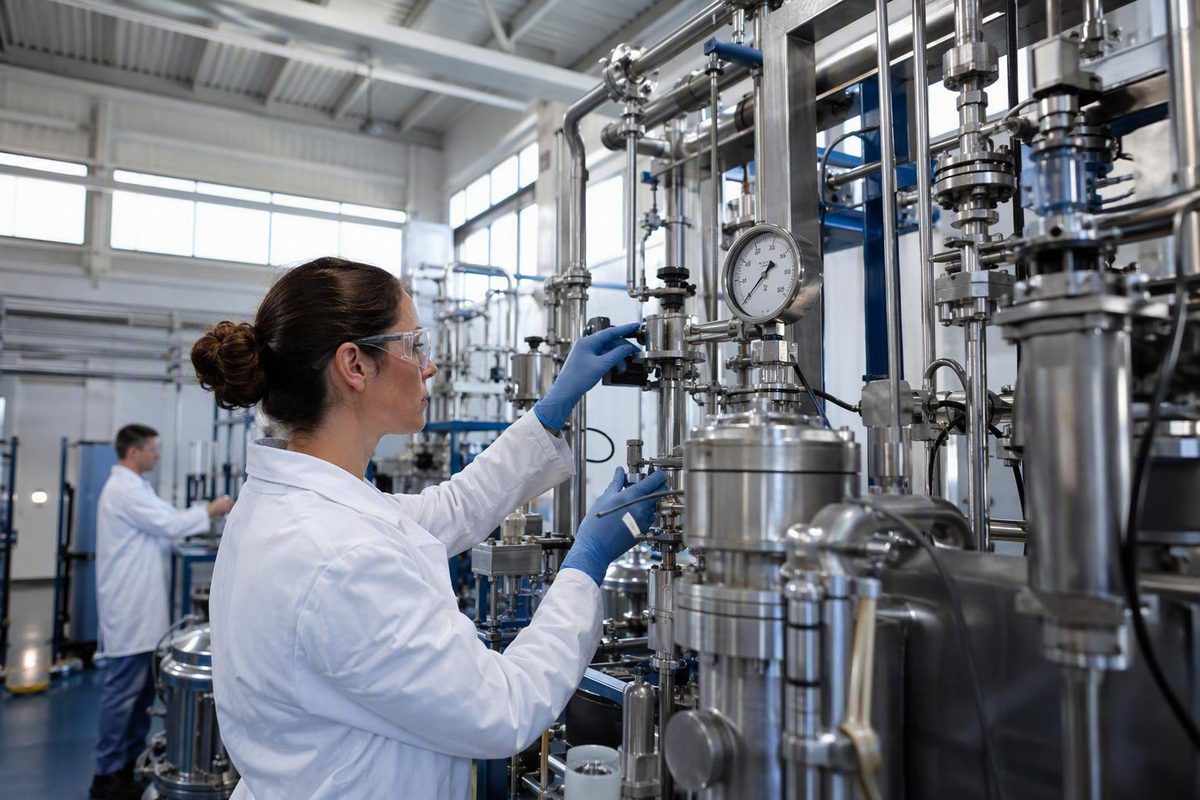
Screen suppliers separately for explicit contract availability and documented hydrogen relevance, rather than assuming one establishes the other.
Specialty contract manufacturing for hydrogen is not a single supplier category. A company that scales a hydrogenation reaction is not interchangeable with a roll-to-roll membrane coater, a fabricator of thermal-management assemblies, or a supplier of composite storage systems.
A useful supplier search must answer five separate questions:
- What product, process, or subassembly must be manufactured?
- Which production and commercial model fits the work?
- Does the supplier have relevant hydrogen experience?
- Does it accept the required type of third-party program?
- Can the proposed facility meet the program’s scale, quality, testing, documentation, and commercial requirements?
The available evidence supports a segmented, non-exhaustive supplier landscape and a rigorous qualification process—not a definitive ranking or complete directory. Most provider evidence is first-party marketing material. It can identify candidates, but it does not establish that a supplier is qualified for a particular application.
Buyers should verify claims at the product, process, facility, line, and program levels before awarding work.
What specialty contract manufacturing means in the hydrogen sector
Contract manufacturing generally means hiring a third party to produce components or finished products against defined requirements and timelines. Depending on the program, it can cover prototypes, low-volume launches, temporary capacity expansion, recurring component production, or finished products, as described in NetSuite’s contract-manufacturing partner selection overview.
In the hydrogen sector, the term usually does not mean producing or supplying hydrogen gas. More often, the outsourced work involves:
- Specialty chemistry in which hydrogen is a reagent
- Membranes, electrodes, catalyst-coated layers, or related electrochemical components
- Pressure-storage components or complete storage systems
- Heat exchangers, tubing, hoses, bellows, connectors, seals, or related hardware
- Tested subassemblies for electrolyzers, fuel cells, distribution equipment, refueling systems, or hydrogen-powered vehicles
The engagement model matters just as much as the product category:
- Toll processing: The buyer supplies a process, feedstock, or intermediate and pays the manufacturer to perform specified processing.
- Build-to-print production: The supplier manufactures against buyer-controlled drawings, bills of material, specifications, and test requirements.
- Design-to-spec: The buyer defines performance and interface requirements while the supplier develops some or all of the design.
- Co-development: The parties jointly refine the product and manufacturing process through laboratory, prototype, and pilot stages.
- Component fabrication or coating: The supplier performs a specialist operation such as membrane casting, electrode coating, machining, molding, joining, or surface treatment.
- Subassembly integration: The supplier fabricates or sources components, assembles them, and may conduct inspection and acceptance testing.
- Direct system supply: The supplier sells its own configured product or system rather than opening its production assets to buyer-controlled contract work.
Two facts must therefore be established independently:
- Hydrogen relevance
- Availability for the required contract or supply model
A supplier may have clear hydrogen experience while offering only proprietary products or selectively awarded direct-supply programs. Conversely, a general contract manufacturer may possess potentially relevant machinery but have no documented hydrogen project, process qualification, or facility-specific controls.
Terminology creates another trap. Hydrogenation chemistry, hydrogen-energy equipment, and hydrogen storage all involve hydrogen, but they are different manufacturing categories. Hydrogenation is a chemical-processing service. Electrolyzer and fuel-cell manufacturing involves electrochemical materials and engineered components. Storage involves pressure-containing products, interfaces, manufacturing processes, and validation responsibilities.
They require different supplier searches and cannot be compared as one interchangeable market.
Map the requirement before searching for a supplier
Begin with a manufacturing brief, not a list of company names. Without a defined brief, suppliers may quote against different assumptions, technically dissimilar proposals may appear comparable, and the decision may collapse into a misleading unit-price comparison.
Start by assigning the requirement to a primary value-chain segment.
Specialty hydrogenation chemistry
For a chemical program, define:
- Target reaction and intended transformation
- Feedstocks, reagents, catalysts, solvents, and intermediates
- Buyer-identified physical and chemical hazards
- Required operating range
- Laboratory, proof-of-concept, pilot, validation, or commercial stage
- Target batch size and annual batch expectations
- Addition, sampling, separation, isolation, drying, packaging, and storage needs
- Analytical methods and release criteria
- Waste streams and handling responsibilities
- Whether the engagement is development, tolling, technology transfer, or recurring supply
A supplier’s ability to perform one high-pressure chemistry does not establish compatibility with another. The buyer must compare its documented process requirements with the proposed reactor train, materials, feed systems, downstream equipment, cleaning arrangements, analytical support, and operating controls.
Electrolyzer and fuel-cell membranes, electrodes, and coated layers
For electrochemical components, specify:
- Membrane, electrode, catalyst-coated membrane, or other layer construction
- Substrate composition, width, thickness, surface condition, and handling limits
- Coating formulation, solids content, solvent system, catalyst, and additives
- Wet- and dry-thickness targets
- Cross-web and down-web uniformity requirements
- Acceptable defect types, frequency, and inspection method
- Drying profile and residual-solvent requirements
- Cleanliness, contamination, moisture, and particulate controls
- Slitting, lamination, converting, packaging, and storage scope
- Laboratory sample, pilot roll, qualification lot, and production volumes
- Ownership of process settings and scale-up knowledge
Maximum web width is only an initial compatibility check. It does not establish usable coating width, production speed, drying capacity, changeover losses, yield, inspection coverage, catalyst-handling capability, or available production windows.
Hydrogen storage
For storage components or systems, define:
- Whether the requirement covers a finished tank, liner, overwrap, boss, valve interface, mounting hardware, or integrated system
- Buyer-controlled versus supplier-controlled design
- Envelope, interfaces, and mass constraints
- Materials and manufacturing route
- Pressure and service conditions defined by the approved product requirements
- Duty cycle and environmental exposure
- Sensor, valve, plumbing, mounting, and protection scope
- Validation ownership and required records
- Vehicle, stationary, distribution, or industrial application
- Intended countries and sales jurisdictions
- Prototype, qualification, and serial-volume forecasts
The commercial model is particularly important. A supplier that manufactures its own storage architecture may not accept an outside design or build-to-print program.
Thermal-management and fluid-conveyance hardware
For heat exchangers, tubing, hose, bellows, connectors, seals, and subassemblies, define:
- Materials and material condition
- Dimensions, tolerances, interfaces, and surface requirements
- Fluid composition and service conditions
- Buyer-approved pressure, temperature, vibration, cycling, and environmental requirements
- Joining and cleaning scope
- Purchased components and approved-source requirements
- Assembly, inspection, and testing responsibility
- Packaging, preservation, and shipping constraints
- Prototype and serial volumes
- Intended markets and buyer-mandated requirements
The evidence available for this guide does not identify the product-specific standards, codes, test thresholds, or jurisdictional requirements that apply to an individual hydrogen program. Those requirements must be determined by the buyer’s qualified engineering, quality, regulatory, and safety teams and incorporated into the sourcing package.
Separate the production stages
Do not combine all expected demand into one ambiguous request. Distinguish:
- Development samples for formulation or design learning
- Proof-of-concept builds to establish basic feasibility
- Prototypes approximating the intended geometry or construction
- Pilot runs used to evaluate the manufacturing process
- Validation lots produced under defined controls
- Initial commercial quantities during launch
- Temporary overflow capacity for an existing process
- Recurring serial production
Each stage has different economics. A development-oriented partner may tolerate frequent changes but lack production capacity. A high-volume plant may require stable specifications, dedicated tooling, larger minimum orders, and longer scheduling commitments.
The output should be a concise make-versus-buy and manufacturing-model brief stating:
- What remains under buyer control
- What the supplier must develop
- Which assets or expertise justify outsourcing
- Which production stage is being sourced
- Which responsibilities cannot be delegated
- Which evidence is required before the next program phase
That brief becomes the basis for supplier discovery, technical discussions, trial work, and comparable quotations.
A segmented landscape of documented providers
The following matrix is non-ranked and non-exhaustive. The providers occupy different parts of the value chain, and the cited evidence does not show that they accept the same kinds of outside work.
| Provider | Value-chain segment | Documented manufacturing model | Stated development stages | Concrete process or equipment facts | Documented hydrogen relevance | Contract-manufacturing status | Important unresolved questions |
|---|---|---|---|---|---|---|---|
| Pressure Chemical | Specialty reaction chemistry | Process development, piloting, scale-up, initial commercial quantities, and toll manufacturing | Laboratory transfer through pilot and commercial production | Supplier-reported high-pressure capability up to 4,000 psig; hydrogenation and hydroformylation | Hydrogen used in reaction chemistry | Explicit | Reactor and batch sizes, compatible chemistries, isolation equipment, availability, quality scope, and comparable projects |
| Verico Technology | Electrolyzer and fuel-cell membranes, electrodes, and coated layers | Roll-to-roll contract coating, membrane casting, and electrode coating | Laboratory, prototype, pilot, scale-up, and production | Supplier reports two 65-inch production lines, three precision slot-die stations, and flotation ovens | Explicitly identifies electrolyzer, fuel-cell, and related hydrogen-economy components | Explicit | Throughput, yield, speed, available capacity, minimum orders, certifications, and contracted-volume evidence |
| Senior Flexonics | Thermal management and fluid conveyance | Design, fabrication, subassembly integration, testing, and volume manufacture | Design and prototype through serial or high-volume production | Heat exchangers, bellows, expansion joints, corrugated hose, tubing, flexible connectors, and subassemblies | Identifies applications across production, storage, distribution, refueling, fuel cells, and vehicles | Not explicit on the reviewed page | Whether open third-party contract programs are accepted; proposed facility, capacity, scope, and qualification evidence |
| Forvia | Type 4 hydrogen storage systems | Direct system supply under a reported customer award | Reported serial supply and planned expansion | Type 4 storage-system manufacturing activity | Reported contract for systems used in medium-duty trucks | No open contract-manufacturing offer established | Current program status, production site, outside capacity, build-to-print availability, and access to validation data |
| SLB | General precision manufacturing and complex assemblies | Contract manufacturing, design support, machining, molding, seals, electronics, additive manufacturing, assembly, testing, and automation | Design support through scaled production | Broad multi-process manufacturing capabilities | No hydrogen market, project, standard, or qualification named in the reviewed evidence | Explicit generally | Hydrogen-specific materials knowledge, references, controls, facility qualifications, testing, and certification scope |
Pressure Chemical: hydrogenation and specialty chemistry
Pressure Chemical advertises process development, pilot work, process validation, scale-up, initial commercial quantities, and toll manufacturing. Its specialties include hydrogenation and hydroformylation, and it states a maximum high-pressure operating capability of 4,000 psig.
That evidence is relevant when the requirement is a reaction process involving hydrogen. It does not establish that the company manufactures hydrogen gas, electrolyzers, fuel cells, storage tanks, or hydrogen-production equipment.
The reported pressure capability also does not prove suitability for a particular chemical process or hydrogen-energy application. A chemical buyer must still verify the proposed equipment, working volumes, materials, compatible feedstocks, downstream isolation, cleaning arrangements, analytical support, batch constraints, availability, and buyer-defined safety requirements.
Verico Technology: roll-to-roll electrochemical coating
Verico explicitly advertises contract coating for electrolyzer, fuel-cell, and related hydrogen-economy components. It identifies membrane casting and electrode coating, with support from laboratory and pilot work through production.
The supplier reports two 65-inch-wide production lines with three precision slot-die coating stations and flotation ovens. It also reports single-digit-percentage coating-thickness variation, but the reviewed page does not provide the definition, measurement method, product basis, sample size, or independent validation behind that statement.
This is the clearest match in the reviewed evidence between an explicit contract service and a hydrogen-technology component category. However, the source does not document actual throughput, historical yields, current capacity, minimum orders, named customers, or contracted production volumes.
The equipment description is therefore a reason to investigate—not proof that the line is production-ready for a particular membrane, electrode, catalyst, substrate, or solvent system.
Senior Flexonics: thermal and fluid subassemblies
Senior Flexonics markets hydrogen-related heat exchangers, bellows, expansion joints, corrugated hose, tubing, flexible connectors, and complete subassemblies. It describes engineering, testing, validation, and manufacturing from prototypes through serial or high-volume production.
The reviewed page is explicitly hydrogen-focused but does not label the offering “contract manufacturing.” A central commercial question remains unresolved: whether the company accepts open build-to-print, design-to-spec, or co-development programs from outside buyers and under what conditions.
A buyer should also identify the exact proposed site, production line, engineering team, testing location, available capacity, design authority, and validation responsibilities.
Forvia: direct hydrogen-storage supply
A November 2023 CompositesWorld report stated that Forvia had secured a contract to supply Type 4 hydrogen storage systems for medium-duty commercial trucks in North America. Production was then scheduled to begin in 2025, and a French facility was described as targeting annual capacity of 100,000 tanks by 2030.
The 2025 start date was forward-looking when published and has now passed. The supplied evidence does not confirm whether production began as scheduled. The 2030 capacity figure also remains a target rather than a demonstrated current output.
The reported award establishes hydrogen-storage manufacturing activity. It does not establish that Forvia offers open tolling, build-to-print production, or third-party manufacturing using customer-controlled designs. Buyers should treat Forvia as evidence of a direct system supplier unless current information or direct confirmation establishes another commercial model.
SLB: explicit contract manufacturing without documented hydrogen experience
SLB explicitly markets contract manufacturing for complex technologies. Its stated capabilities include machining, molding, specialty seals and elastomers, electronics, assembly, testing, additive manufacturing, automation, and related engineering support.
The reviewed source, however, names no hydrogen market, customer, project, standard, product, or hydrogen-specific qualification. This creates the inverse of the Senior Flexonics gap: SLB clearly offers general contract manufacturing, but the available evidence does not establish hydrogen experience.
Broad energy-sector, pressure, or extreme-condition experience must not be converted into an unsupported claim of hydrogen suitability.
The two-axis screen
A practical initial screen plots suppliers on two independent axes:
| Lower documented hydrogen experience | Higher documented hydrogen experience | |
|---|---|---|
| Explicit contract availability | Potential capability supplier requiring hydrogen-specific qualification | Stronger initial candidate, still requiring product and facility qualification |
| Unclear contract availability | Weak fit unless direct confirmation changes the evidence | Relevant hydrogen supplier requiring confirmation that the proposed outside program is accepted |
On the reviewed evidence:
- Pressure Chemical and Verico have explicit contract models and defined hydrogen-related categories.
- Senior Flexonics has documented hydrogen relevance but unclear open contract availability.
- SLB has explicit general contract availability but no documented hydrogen-specific experience.
- Forvia has documented hydrogen-system supply but no established open contract-manufacturing offer.
This is not a quality ranking. It is a map of what the evidence does and does not establish.
Compare development, scale-up, and production readiness
A supplier may be capable of producing one sample yet poorly suited to stabilize the process, validate it, and deliver repeatable production. Qualification should therefore map every candidate against the complete development path.
| Stage | Evidence to request |
|---|---|
| Laboratory development | Relevant equipment, material-handling limits, development methods, assigned technical staff, and experiment records |
| Proof of concept | Defined success criteria, sample plan, analytical or dimensional results, and identified scale-up risks |
| Prototype | Representative materials and geometry, configuration control, inspection results, and deviation records |
| Pilot | Process window, repeatability data, preliminary work instructions, yield and scrap data, and bottleneck analysis |
| Process validation | Approved plan, controlled inputs, calibrated equipment, lot genealogy, results, deviations, and sign-offs |
| Initial commercial quantities | Scheduling model, material plan, release process, nonconformance handling, and launch support |
| Serial or high-volume production | Demonstrated capacity, control plan, maintenance strategy, staffing, supply continuity, and change governance |
Pressure Chemical presents a supplier-stated chemical pathway from laboratory process development through pilot work, scale-up, and initial commercial or toll production. Verico describes laboratory, pilot, and production-scale coating. Senior Flexonics describes design-through-testing and prototype-through-volume manufacturing, although its availability for the buyer’s desired commercial model still requires confirmation.
Published equipment dimensions and global footprints are not capacity data. A wide coating line may already be committed. A large reactor may not fit the buyer’s batch size or isolation method. A network of facilities may not share the same processes, certifications, customer approvals, or technical staff.
Request operating data for the exact proposed asset:
- Minimum and maximum batch or lot sizes
- Usable width, working volume, or dimensional envelope
- Normal and maximum operating speeds
- Historical first-pass and final yields for comparable work
- Changeover and cleaning time
- Current utilization and committed backlog
- Available development and production windows
- Raw-material and finished-goods storage limits
- Minimum order quantities
- Planned maintenance shutdowns
- Staffing by shift
- Expansion assumptions and practical constraints
The process-transfer plan should identify:
- Controlled recipes, drawings, or work instructions
- Buyer-owned and supplier-owned tooling
- Process parameters and permitted operating windows
- Control plans and inspection methods
- Sampling and release rules
- Review gates and authorized signatories
- Deviation and nonconformance handling
- Engineering-change control
- Validation records and retention periods
- Training requirements
- Ownership and permitted use of process improvements
Map the physical production chain as well. Determine whether fabrication, coating, cleaning, joining, assembly, inspection, and acceptance testing occur at the reviewed facility or across several sites. The location of final assembly and testing is especially important when components cross facilities, as emphasized in FORGE’s contract-manufacturer selection checklist.
Qualify technical fit, quality systems, and testing at the facility level
“Hydrogen capable” is too broad to be a qualification result. Suitability must be assessed against the buyer’s specific product, process, materials, operating requirements, intended markets, and proposed production facility.
The current evidence pack does not contain authoritative hydrogen-specific standards or regulatory guidance. This article therefore does not prescribe codes, test thresholds, cleaning procedures, pressure limits, purity levels, or conformity routes. Qualified engineering, quality, regulatory, and safety personnel must determine the applicable requirements for the product and jurisdiction.
Once those requirements are defined, the supplier should establish a traceable match between the proposed product and:
- Named manufacturing site
- Specific production line and equipment
- Assigned engineering and quality personnel
- Approved materials and suppliers
- Controlled procedures and work instructions
- Inspection and test methods
- Calibration system
- Data and record-retention practices
- Packaging and shipment controls
- Applicable certification scope
The supplier’s response should explain how it will comply with the buyer-approved requirements relevant to the program. Depending on the product, the sourcing package may contain requirements concerning materials, contamination, cleaning, joining, traceability, inspection, testing, hazardous operations, documentation, or release.
Do not copy generic thresholds or codes into an RFP without qualified review confirming that they apply to the product, service conditions, and sales jurisdictions.
Coating qualification
For membrane and electrode coating, request evidence covering:
- Thickness measurement method and measurement-system capability
- Cross-web and down-web uniformity
- Edge behavior and usable coated width
- Start-up, shutdown, splice, and changeover losses
- Defined defect taxonomy
- Visual or automated inspection coverage
- Sampling frequency
- Yield history for comparable materials
- Coating-solution preparation and hold-time controls
- Drying profile and oven zoning
- Substrate handling and tension control
- Program-specific contamination controls
- Slitting, converting, packaging, and storage
- Traceability from incoming materials to finished rolls
Verico reports single-digit-percentage coating-thickness variation on its hydrogen coating page, but this remains a supplier statement rather than independently verified performance. Before using it in a sourcing decision, request the definition of variation, measurement method, product basis, sample size, underlying data, and acceptance criteria.
Fluid and thermal subassembly qualification
For heat exchangers, tubing, bellows, hoses, connectors, and integrated assemblies, request:
- Material records and traceability
- Applicable forming, machining, joining, and cleaning procedures
- Qualification and training records for assigned personnel
- Dimensional and surface-inspection plans
- Buyer-approved performance and durability test plans
- Test-fixture and instrumentation controls
- Defined responsibility for product and system validation
- Evidence from products with comparable materials and service conditions
- Nonconformance history and corrective-action examples
- Configuration and supplier-change controls
Senior Flexonics lists ISO 9001, ISO 14001, and IATF 16949 on its hydrogen capability page. That company-level presentation does not prove that every certification covers every facility, line, process, or product.
Buyers should obtain current certificates and verify:
- Certified legal entity
- Facility address
- Standard and revision
- Certification body
- Scope and exclusions
- Covered products and processes
- Issue and expiration dates
- Whether the proposed operation falls within scope
The same principle applies to SLB’s broader published certification list. A general corporate list does not establish the scope of certification at the proposed facility.
Certification can indicate that a management framework exists. It does not replace product-specific qualification, applicable compliance work, process validation, or lot acceptance.
People and governance
Facility qualification should cover the operating organization as well as the equipment. Review:
- Project leadership and escalation authority
- Engineering and quality oversight
- Operator training and qualification
- Staffing continuity and succession
- Maintenance and spare-parts strategy
- Calibration status and out-of-tolerance handling
- Technical-review gates
- Deviation and corrective-action processes
- Experience with intended sales markets
- Document control and data integrity
- Customer-notification practices
A corporate capability presentation cannot substitute for records from the proposed production line.
Expose subcontracting, capacity, and continuity risk
The prime supplier may perform only part of the production route. Undisclosed subcontracting can add transportation, handling, contamination, schedule, quality, intellectual-property, and change-control exposure.
Require a process and chain-of-custody map showing:
- Incoming material source and receipt location
- Every internal manufacturing operation
- Every subcontracted operation
- Responsible legal entity and physical site
- Material handoffs and transport conditions
- Intermediate inspection and release points
- Cleaning and preservation stages
- Final assembly location
- Acceptance-test location
- Packaging, storage, and shipment location
For each subcontractor, ask:
- How was it selected and qualified?
- Which certifications and approvals apply?
- How is performance monitored?
- How often is it audited?
- Who controls specifications and process changes?
- Must the buyer approve substitutions or site changes?
- Can the prime supplier replace it?
- Does an approved alternative already exist?
- Who owns and can access the resulting records?
Capacity assessment should focus on actual constraints rather than general statements that production is “scalable.” Review bottleneck equipment, qualified staffing, maintenance schedules, calibration, spare tooling, single-source materials, storage restrictions, utility dependencies, and other single points of failure.
The risk review should cover:
- Raw-material shortages
- Equipment failure
- Tool damage or loss
- Inventory and planning errors
- Subcontractor delay or quality failure
- Utility interruption
- Facility disruption
- Cyber or production-system interruption
- Transportation constraints
- Regulatory or permit disruption
- Financial distress or insolvency
Geographic fit is more than distance. A nearby supplier may depend on a remote sub-tier processor or an unfamiliar regulatory route. Consider hazardous-material logistics, shipment constraints, customs exposure, lead-time variability, access for audits, and familiarity with the intended markets.
Require a business-continuity and recovery plan proportionate to the program. It should address alternative sources, spare equipment or tooling, recovery priorities, data backup, emergency contacts, escalation paths, and notification deadlines.
Financial due diligence should also reflect the relationship’s strategic importance and expected duration. A one-off prototype order does not require the same review as a multi-year, single-source production award.
Build the RFP and commercial agreement around verifiable deliverables
A strong request for proposal makes supplier responses comparable and prevents broad capability language from replacing evidence.
RFP scope
Include:
- Product or process definition
- Current design and development maturity
- Forecast volumes by phase and period
- Specifications and controlled documents
- Buyer-supplied and supplier-supplied materials
- Required manufacturing operations
- Inspection and acceptance criteria
- Testing and validation responsibility
- Documentation and record-retention requirements
- Intended countries and markets
- Prototype, qualification, and launch schedule
- Required response structure
- Assumptions suppliers must identify
- Confidentiality and data-handling requirements
Where information remains uncertain, say so. Require suppliers to distinguish existing capability from capability dependent on development work, capital expenditure, subcontracting, or schedule changes.
Facility-specific evidence request
Require:
- Proposed facility and production line
- Equipment list and relevant operating envelope
- Available capacity and scheduling windows
- Comparable-project evidence
- Sample, feasibility, or pilot-run plan
- Quality metrics for relevant processes
- Current certifications and exact scopes
- Maintenance and calibration records
- Relevant regulatory or audit history
- Customer references where permitted
- List of subcontractors and outsourced operations
- Final assembly and test locations
- Staffing and technical-oversight plan
- Business-continuity summary
Commercial response
Ask suppliers to separate:
- Nonrecurring engineering
- Process development
- Tooling and fixtures
- Qualification and validation
- Raw materials
- Conversion or processing charges
- Inspection and testing
- Packaging
- Freight and hazardous-material handling
- Storage
- Scrap and yield assumptions
- Expedite charges
- Minimum order quantities
- Minimum batch or campaign sizes
- Prototype and production lead times
- Payment milestones
- Taxes and duties
- Assumptions that trigger repricing
This structure reveals whether a low unit price depends on high yields, large orders, buyer-owned inventory, limited testing, or a narrow interpretation of the specification.
Intellectual property and data
Define ownership and access rights for:
- Tooling and fixtures
- Drawings and design files
- Recipes and formulations
- Process parameters and work instructions
- Software and test scripts
- Inspection and validation data
- Background intellectual property
- Program-specific foreground intellectual property
- Process improvements
- Supplier know-how embedded in production
- Data required to transfer production elsewhere
The agreement should state what each party may use outside the program, how confidential information will be protected, and what happens to materials, data, tooling, and work in progress after termination.
Governance and remedies
The contract and quality agreement should establish:
- Technical and commercial review gates
- Required sign-offs
- Change-notification and approval rules
- Deviation authority
- Inspection and audit rights
- Acceptance and rejection processes
- Corrective-action deadlines
- Defect remediation and rework rules
- Warranty allocation
- Delivery and escalation expectations
- Dispute resolution
- Termination rights and transition support
- Record access and retention
- Subcontractor governance
- Continuity and recovery obligations
Before final award, use site tours, interviews with assigned staff, samples or paid trial runs, reference checks, and proportionate financial or compliance review.
Concise evidence-request template
Use a ledger that separates assertions from proof:
| Requirement | Supplier claim | Documentary proof | Third-party certification | Customer validation | Buyer verification | Unresolved gap or action |
|---|---|---|---|---|---|---|
| Proposed process | ||||||
| Exact facility and line | ||||||
| Hydrogen-relevant experience | ||||||
| Materials and operating envelope | ||||||
| Inspection and testing | ||||||
| Yield and quality performance | ||||||
| Available capacity | ||||||
| Certification scope | ||||||
| Subcontracted operations | ||||||
| Continuity plan |
The final column is critical. An unknown is not automatically a failure, but it must remain visible until it is resolved, accepted as a documented risk, or converted into a contractual condition.
Make the shortlist without overclaiming
Use pass/fail gates before applying a weighted score. A supplier should not advance merely because it has a recognizable name, an impressive facility, or broad energy-sector experience.
Recommended gates are:
- Correct manufacturing segment: The supplier performs the required chemistry, coating, fabrication, integration, or system supply.
- Engagement availability: It explicitly accepts the required tolling, build-to-print, co-development, or direct-supply model.
- Facility and process fit: The proposed site and equipment can handle the defined materials, dimensions, process conditions, and operations.
- Feasible scale: The supplier can support the current stage and credible future demand.
- Required evidence: It will provide the documentation, traceability, testing, and audit access the program requires.
- Acceptable commercial model: Minimums, lead times, pricing, intellectual-property terms, and allocation of responsibility are workable.
Only suppliers that pass these gates should enter a weighted comparison. Scored categories might include:
- Relevant product or system experience
- Development and industrialization support
- Equipment and process fit
- Inspection and testing resources
- Quality controls and certification scope
- Available capacity and scheduling
- Subcontractor exposure
- Logistics and jurisdictional familiarity
- Program management and communication
- Financial stability
- Business continuity and recovery
- Commercial and intellectual-property terms
Weight the strength of the evidence as well as the criterion itself. Facility records, scoped certificates, controlled procedures, trial results, and relevant customer validation deserve more weight than corporate marketing statements. Every score should have an evidence source, owner, and date. Unknowns should not silently receive an average score.
Do not rank Pressure Chemical, Verico, Senior Flexonics, Forvia, and SLB as interchangeable “best hydrogen manufacturers”:
- Pressure Chemical represents specialty reaction chemistry.
- Verico represents electrochemical roll-to-roll contract coating.
- Senior Flexonics represents hydrogen-relevant thermal and fluid hardware, with open contract availability still to be confirmed.
- Forvia represents direct hydrogen-storage system supply, not proven open contract capacity.
- SLB represents broad contract manufacturing without documented hydrogen-specific qualification in the reviewed evidence.
Several questions require direct confirmation:
- Senior Flexonics must confirm whether it accepts the buyer’s proposed third-party engagement model.
- SLB must provide hydrogen-specific evidence for the proposed facility, process, materials, and personnel.
- Forvia must confirm current program status and whether any build-to-print or outside contract capacity is available.
- Every candidate must identify the exact facility, line, available capacity, outsourced operations, testing responsibilities, and certification scope proposed for the work.
When documentation cannot establish process fit, use a paid feasibility study, sample run, or pilot phase. Define acceptance gates before work begins:
- Deliverables
- Test and inspection methods
- Acceptance criteria
- Data ownership
- Schedule
- Review points
- Authorized signatories
- Conditions for proceeding to qualification or production
The decision rule is straightforward: select the partner whose verified facility-level evidence best matches the specific product, process, volume, jurisdiction, and validation burden—not the supplier with the broadest marketing claims.
Frequently asked questions
Is hydrogenation contract manufacturing the same as manufacturing electrolyzers or hydrogen equipment?
No. Hydrogenation contract manufacturing is a chemical-processing service in which hydrogen participates in a reaction. Manufacturing electrolyzers or fuel cells involves components such as membranes, electrodes, coated layers, machined hardware, seals, and assembled systems.
Pressure Chemical’s documented relevance is high-pressure reaction chemistry. Verico’s documented relevance is roll-to-roll coating for electrolyzer and fuel-cell components. The common word “hydrogen” does not make the two suppliers interchangeable.
Which provider in this evidence explicitly offers contract manufacturing for hydrogen-technology components?
Verico Technology most directly matches both conditions for electrochemical components. It advertises roll-to-roll contract coating for electrolyzer, fuel-cell, and related hydrogen-economy components, including membrane casting and electrode coating.
Pressure Chemical also explicitly offers contract manufacturing involving hydrogenation chemistry, but that is chemical processing rather than hydrogen-technology hardware. The appropriate provider depends on whether the requirement is an electrochemical layer or a specialty chemical product.
Does a high-pressure rating prove that a manufacturer is qualified for hydrogen service?
No. A pressure rating is an equipment or operating-envelope claim. It does not establish suitability for the buyer’s specific product, materials, process, interfaces, controls, inspection plan, testing requirements, or jurisdiction.
Pressure Chemical reports a maximum high-pressure capability of 4,000 psig on its chemical contract-manufacturing page. That figure concerns its chemical-processing offering and is not proof of qualification for a particular hydrogen application.
SLB describes broad extreme-condition manufacturing experience, but its reviewed page does not document hydrogen-specific qualifications. In both cases, the buyer needs product-, process-, and facility-specific evidence assessed against requirements established by qualified personnel.
Which certifications should a buyer verify when evaluating a hydrogen manufacturing partner?
Verify the certifications and approvals required by the product, process, industry, intended markets, and customer requirements. There is no universal certification checklist established by the evidence used for this guide.
For each cited certification, confirm:
- Legal entity and facility address
- Standard and current revision
- Certification body
- Scope and exclusions
- Covered products and processes
- Issue and expiration dates
- Whether the proposed production operation is included
Senior Flexonics lists ISO 9001, ISO 14001, and IATF 16949. SLB publishes a broader certification list for its manufacturing organization. Neither company-level presentation proves that every certification applies to every facility, line, process, or product.
Certifications support due diligence but do not replace product qualification, applicable compliance work, process validation, or lot acceptance.
Does Forvia’s Type 4 tank contract mean it offers contract manufacturing to outside customers?
No. The reported award establishes that Forvia secured a supply contract for Type 4 hydrogen storage systems. It does not establish an open contract-manufacturing service, available build-to-print capacity, or willingness to manufacture an outside customer’s design.
A prospective buyer should ask Forvia directly about current program status, production sites, available capacity, commercial model, design ownership, minimum volumes, validation responsibilities, and whether outside contract programs are accepted.
The right partner cannot be selected from a generic list of hydrogen manufacturers. Define the product, process, volume, jurisdiction, validation burden, and engagement model first. Then screen separately for explicit contract availability and documented hydrogen relevance. Treat the providers above as examples of distinct categories, and award work only after facility-level capabilities, testing responsibilities, capacity, subcontracting, quality controls, intellectual-property terms, and continuity plans have been verified.