
Turn Restoration Search Visibility Into Qualified, Profitable Jobs
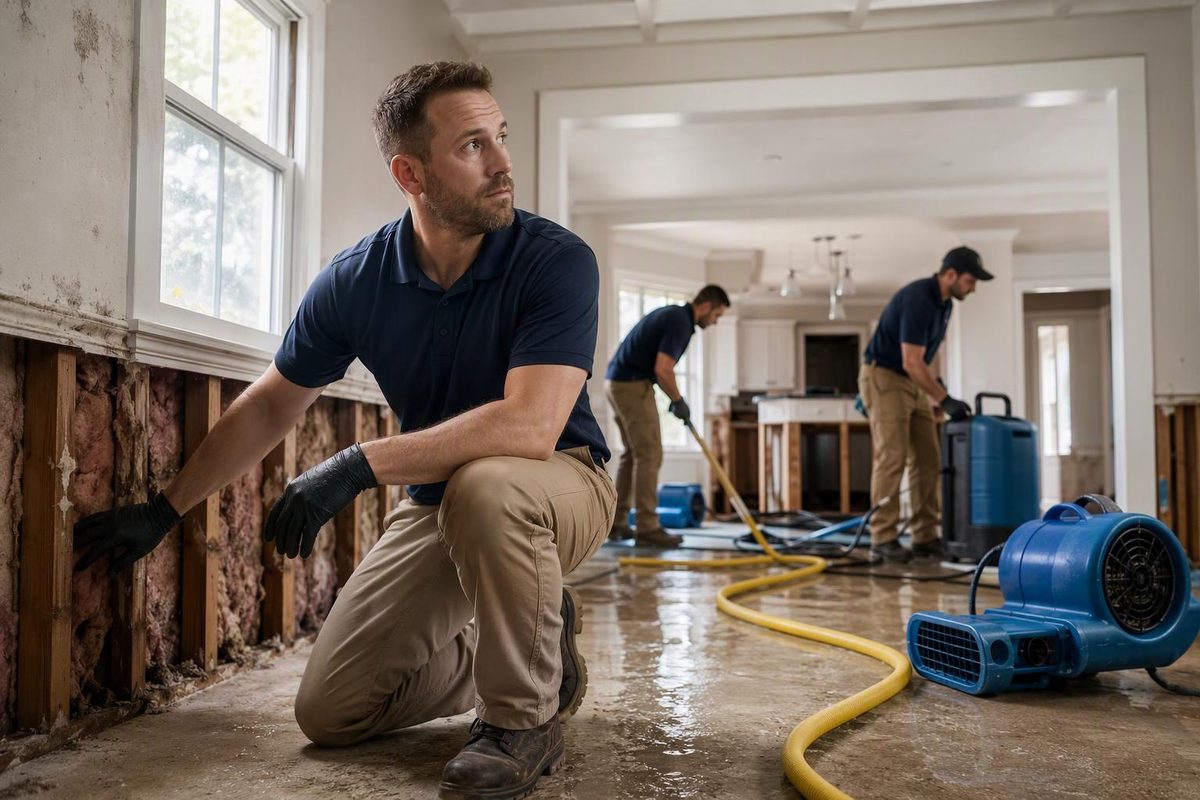
Turn restoration search visibility into qualified losses and authorized jobs with service pages, local proof, fast response and pipeline reporting.
Restoration company SEO lead generation works when the site matches urgent searches to a service the contractor actually provides, confirms legitimate coverage and turns the enquiry into a fast response. Measure success in qualified losses, authorized jobs and gross profit—not rankings, traffic or form fills alone.
Enter one month of enquiries, qualified losses and authorized jobs to find the largest measurable pipeline drop.
Restoration Lead Funnel Check
Use totals from the same reporting period and channel group. No industry benchmark is assumed.
A flooded basement may create immediate demand, while a facilities manager researching disaster-response vendors may take weeks. The pages, calls to action and reporting system need to support both paths without treating every search as equally valuable.
Match Each Search to the Actual Restoration Job
Start with the work the company can perform and the distance crews can cover profitably. Separate demand by service instead of forcing every visitor through a broad disaster-restoration page.
| Search need | Best destination | Primary action |
|---|---|---|
| Emergency water extraction | Water-damage service page | Call emergency line |
| Fire and smoke cleanup | Fire-restoration service page | Request immediate assessment |
| Mold concern | Mold-remediation page | Ask for an inspection |
| Large commercial loss | Commercial-restoration page | Reach the commercial team |
| Immediate safety question | Safety-focused guide | Call when help is needed |
| City plus service | Substantive local service page | Confirm availability and call |
A service page should resolve operational questions before adding promotional copy:
- Is help available now or only during stated hours?
- Which property and loss types are accepted?
- What happens after the first call?
- Which areas can crews realistically reach?
- Are inspection, extraction, drying, cleaning and reconstruction handled in-house?
- Which licenses, certifications or affiliations can be verified?
- How are estimates, documentation and insurer communication handled?
Use the distinctions the field team uses. IICRC lists separate certifications for Water Damage Restoration Technician, Applied Structural Drying Technician, Fire and Smoke Damage Restoration Technician and Applied Microbial Remediation Technician. Claim only credentials the company or named technicians currently hold (IICRC certifications offered).
Mold claims require particular care. The EPA says it does not certify mold inspectors or remediation firms, although states and organizations may impose their own requirements. It advises property owners to assess qualifications, training, experience and references (EPA guidance, updated January 14, 2026). Check every licensing and certification statement against the applicable state and local rules.
Keep the Google Business Profile Consistent With Operations
A restoration contractor that visits damaged properties is usually a service-area business unless it also receives customers at a staffed storefront. Google says a service-area business should have one profile for its central office. A virtual office is not eligible unless it is staffed during business hours. Separate profiles are allowed for real locations with separate staff and service areas, not rented addresses used to manufacture local reach (Google Business Profile guidelines).
Configure the profile to match how the company operates:
- Use the real-world business name without adding cities or services as keywords.
- Select the fewest categories needed to describe the core business.
- Hide the address if customers are not served there.
- Enter only cities or postal areas crews genuinely cover.
- State 24-hour availability only if someone can answer and dispatch around the clock.
- Add current services, working phone numbers and job photos for which publication permission exists.
Google permits up to 20 service areas and says the overall boundary generally should not extend beyond roughly two hours’ driving time from the business base (service-area instructions). Adding territory to the profile does not create an operational presence there.
Request reviews from real customers after an appropriate milestone, such as completed mitigation or final sign-off. Do not offer a discount or benefit in return. Google classifies reviews influenced by payment, free services or another benefit as incentivized (Maps review policy). Replies should also protect customer privacy; do not reveal details about a loss that the reviewer did not make public.
Create Local Pages Only Where Evidence Supports Them
Create a city or regional page only when the company has a meaningful case for serving that market. Useful evidence includes:
- the dispatch location and realistic response coverage;
- locally relevant building or weather conditions;
- anonymized completed-project examples used with permission;
- a local phone route or team responsible for the area;
- services available in that market;
- applicable local licensing details.
Do not publish near-identical pages that merely replace the city name. Google classifies substantially similar regional pages that funnel visitors to one destination as doorway abuse. It also identifies blocks of city names as keyword stuffing (Google Search spam policies). If five towns would receive essentially the same content, one strong regional page may be the more defensible choice.
Add LocalBusiness structured data with accurate business details where appropriate. Structured data can help Google understand the page, but it does not guarantee a special search result. Google recommends validating the markup with the Rich Results Test and checking deployed pages through Search Console’s URL Inspection tool (LocalBusiness documentation). Markup should describe the real business; it cannot create a location the company does not operate.
Publish Answers That Reduce Customer Uncertainty
Supporting content should come from recorded sales and field questions rather than a generic keyword list. Interview dispatchers, estimators, project managers and technicians. Useful subjects include:
- what to do before a crew arrives after a supply-line break;
- water extraction versus structural drying;
- what documentation a property owner receives;
- which belongings may be cleaned after smoke exposure;
- how commercial response differs from residential work;
- when reconstruction begins after mitigation;
- what a restoration company can and cannot promise about insurance coverage.
Have the relevant practitioner review technical or safety-sensitive guidance and identify that reviewer. Google recommends original, people-first material with clear sourcing and authorship rather than mass-produced summaries created primarily to attract search traffic (helpful-content guidance). Link each useful guide to its relevant service page and give readers a next action appropriate to the situation.
This content also provides clearer source material for AI answer engines. Specific explanations, attributable expertise and consistent business facts are more useful than unsupported claims or pages assembled from interchangeable location keywords.
Fix Call Handling Before Increasing Search Traffic
An emergency visitor should not have to search for the phone number. Put a tap-to-call action near the top of the mobile page, repeat it after the essential service details and offer a short alternative form. Limit that form to information dispatch needs, such as contact details, property location, loss type and when the incident began.
Test the operation behind each conversion path:
- Call every tracking number from a new phone.
- Submit every form and verify delivery.
- Check whether calls route correctly after hours.
- Measure answer rate and time to first response.
- Confirm that staff capture source, service, location and qualification consistently.
More enquiries will not help if urgent calls reach voicemail or web requests remain unassigned. SEO works best when search demand, buyer behavior and response capacity align; the broader channel-fit test is covered in Lead Generation SEO Works When 3 Conditions Align.
Report Qualified Losses, Authorized Jobs and Profit
Connect the website, call tracking and CRM or job-management system. Configure call tracking so website calls retain traffic-source data while the primary business number remains accurate in the Business Profile and other listings. Disclose call recording where required by applicable law.
Mark meaningful website actions as GA4 key events. Google says key-event reporting can show how often users complete important actions and attribute credit to touchpoints along the path (Google Analytics guidance).
Use one monthly scorecard:
- Organic and Business Profile enquiries
- Answered enquiries
- Qualified losses
- Inspections or site visits
- Authorized jobs
- Revenue and gross profit from those jobs
- Cost per qualified lead and cost per authorized job
Segment the figures by service and service area. Ten commercial-loss enquiries should not be assessed like ten small residential cleanup calls. Search Console can identify the queries and pages earning impressions and clicks, but its traffic and position metrics are diagnostic inputs rather than booked work (Search Console Performance report).
Review the pipeline monthly. Improve pages that attract relevant searches but few enquiries. Fix call handling when qualified prospects are not reached. Examine sales follow-up when inspections fail to become authorized work. Pause content expansion when crews lack capacity or lead quality deteriorates. The target is dependable visibility for work the company can answer, perform and complete profitably.