
How to Choose the Right Critical Tattoo Power Setup
First, which kind of critical power supply do you mean?
“Critical power supply” can refer to two very different product categories:
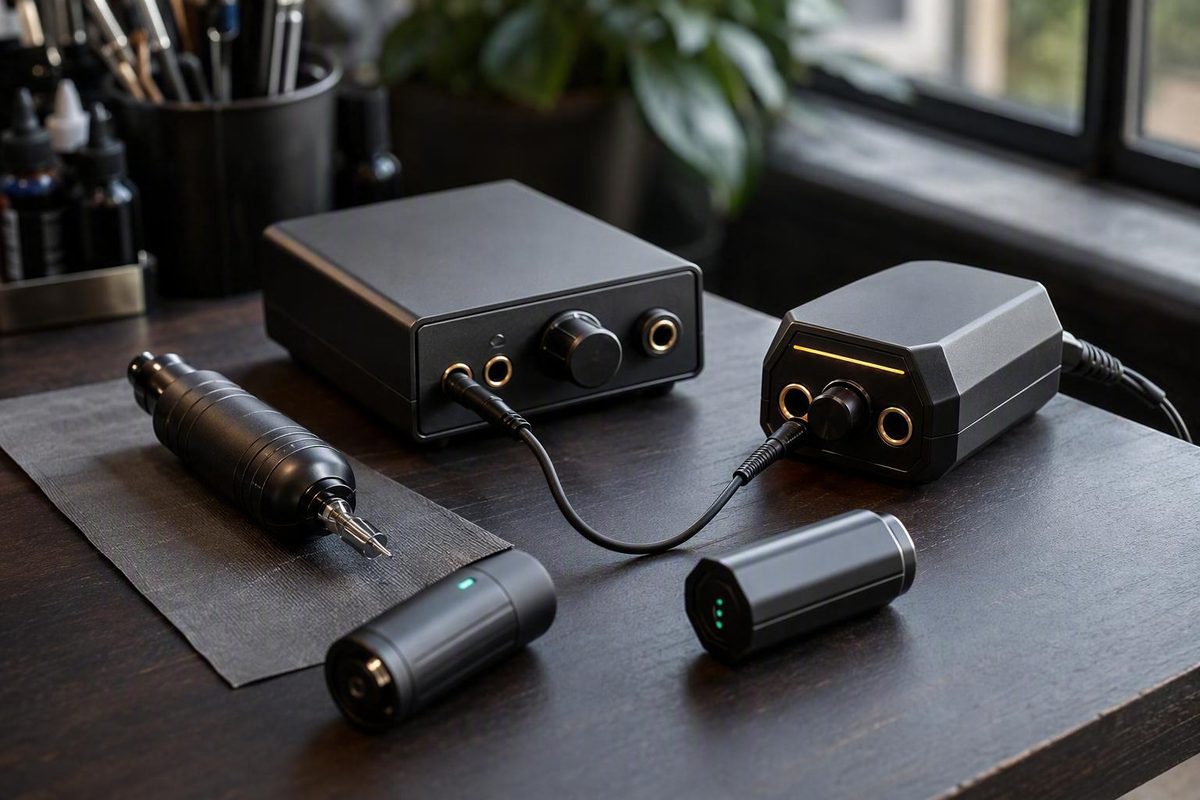
- Critical Tattoo equipment, including desktop tattoo power supplies, wireless batteries, charging docks, bundles, foot switches, adapters, cords, receivers, and mounts.
- Mission-critical electrical infrastructure, such as UPS systems, generators, transfer equipment, and distribution hardware used to keep essential facility loads operating.
This guide primarily addresses the stronger shopping intent: professional tattoo artists and studio buyers comparing Critical Tattoo power options. If you meant power continuity for a hospital, data center, communications site, or industrial facility, jump to the section on mission-critical facility power.
Critical Tattoo separates its catalog into batteries, tattoo power supplies, foot switches, bundles, and accessories. Its power-supply collection therefore includes more than conventional desktop units: it also displays wireless batteries, charging docks, cords, adapters, and packages containing several components. Critical Tattoo’s storefront shows the range of products grouped within this category.
Retailers use the term just as broadly. A “Critical power supply” collection may contain a battery that powers a machine, a dock that charges batteries, a receiver that enables wireless control, or a foot switch that changes how the system is operated. Inclusion in the collection does not establish that an item is a standalone desktop power source.
That distinction should determine the first stage of your buying process. Identify whether you need:
- A stationary supply for a corded workstation
- A machine-mounted wireless battery
- Charging equipment for batteries you already own
- A complete battery-and-dock bundle
- A supporting control, connection, or mounting accessory
Only then should you compare models, configurations, and prices.
Desktop power supply or wireless battery: start with the workflow
A desktop tattoo power supply is a stationary power source used as part of a corded workstation. The machine connects to the supply, which generally remains on a counter, tray, stand, shelf, or mount.
A wireless battery mounts to or connects with a compatible tattoo machine. “Wireless” does not mean that the ownership experience is hardware-free: you may still need a charger or dock, spare batteries, an adapter, a receiver, or an optional foot control.
The available evidence does not support declaring either architecture more reliable, efficient, ergonomic, or economical. The appropriate starting point is therefore your workflow.
When a desktop supply may fit
A conventional desktop system is worth considering when:
- You work mainly at one station.
- You are comfortable managing machine and foot-switch cords.
- Your tray or workstation has a secure place for the unit.
- You do not want to manage battery charging and rotation.
- You already own compatible cords and controls.
- Travel portability is not a priority.
A desktop supply can simplify the purchase by removing battery format and dock capacity from the decision. It is not automatically simpler in every other respect. You must still confirm the machine connection, electrical requirements, foot-switch support, physical placement, and included cabling.
When a wireless battery may fit
A wireless system is worth considering when:
- You regularly travel between studios or events.
- You want fewer operating cords around the station.
- You prefer fewer items on the work surface.
- Your machine has a confirmed compatible connection.
- You have adequate charging space and time.
- You can carry a charged spare when continuity matters.
Critical Tattoo presents Critical Connect as its wireless tattoo-power range and says it uses Bluetooth 5.0 technology. That is a manufacturer description of the control ecosystem, not evidence that the system outperforms corded equipment in every workflow. The Critical Tattoo homepage states the Bluetooth technology used by Critical Connect.
Compact decision path
| Your situation | Start by comparing | Verify before buying |
|---|---|---|
| Stationary artist | Conventional desktop supplies | Machine connection, electrical requirements, foot-switch support, cords, and placement |
| Traveling artist | V2 Standard, V2 Shorty, and V3 batteries | Direct fit, adapter needs, charging method, documented runtime, and spare-battery strategy |
| Compact setup | Short-format or machine-mounted options | Added machine length and balance, connector, and charger footprint |
| Multiple machines or batteries in rotation | Compatible batteries plus dual- or quad-slot docks | Battery generation, dock support, slot count, and bundle contents |
Treat this as a route into further verification, not as a model recommendation. A Shorty format may appear attractive for a compact setup, but the supplied material does not establish its dimensions, weight, balance, runtime, or charging time relative to the Standard format.
Critical Connect V2 Standard, V2 Shorty, and V3 compared
The documented differences among these batteries are narrower than their storefront presentation may imply. The evidence establishes product names, identified formats, displayed prices, and several retailer-stated V3 features. It does not support a definitive performance ranking.
Storefront prices checked August 8, 2026: Every price below is a time-sensitive observation, not a guaranteed current selling price. Confirm the live page, selected configuration, taxes, shipping, and availability before ordering.
The Critical Tattoo storefront displayed the V2 Universal Battery at $269.99 and the V2 Universal Shorty Battery at $169.99. It also used Standard and Shorty as recognizable format options, but did not provide enough comparable technical data to quantify the trade-offs between them. The storefront also displayed the V3 Battery at $299.99. These prices appeared on Critical Tattoo’s storefront when checked.
Kingpin Tattoo Supply also displayed the V3 at $299.99 and described it as having a 1.5-inch color display, 2000 mAh battery, session and runtime modes, a magnetic connection, and an RCA converter. These are retailer-stated details, not manufacturer-verified specifications for this comparison. Kingpin’s Critical collection contains the cited V3 price, feature, and connection descriptions.
| Model observed | Identified format | Displayed price | Available connection or compatibility statement | Source type | Evidence limitations |
|---|---|---|---|---|---|
| Critical Connect V2 Universal Battery | Standard/Universal | $269.99 | Retailer listings describe RCA and 3.5 mm versions | Official-storefront price; retailer connection description | No verified comparative runtime, dimensions, weight, charging time, balance, or measured output |
| Critical Connect V2 Universal Shorty Battery | Shorty/Universal | $169.99 | Exact machine support is not established by the supplied official material | Official-storefront price | “Shorty” identifies a format but does not establish performance relative to Standard |
| Critical Connect V3 Battery | Battery with magnetic/direct and converter arrangements described by a retailer | $299.99 | Retailer says direct connection supports Critical Torque and Bishop Power Wand; an RCA converter supports RCA machines | Retailer price and description; official storefront also displayed the price | Features and compatibility require confirmation in current manufacturer documentation; no independent performance testing |
| Not established by available evidence | — | — | — | — | Voltage range, voltage-step precision, maximum output, output accuracy, charging time, independently measured runtime, dimensions, weight, battery degradation, and warranty |
A higher model number does not establish that V3 is better than V2. A higher displayed price, color display, stated battery capacity, or prominent retailer placement also does not prove better voltage performance, longevity, comfort, or value.
Likewise, Standard and Shorty clearly designate different formats, but the evidence does not show that Standard runs longer or that Shorty balances better. Those conclusions would require current specifications and preferably repeatable measurements using comparable machines, loads, voltages, battery conditions, and test procedures.
Conventional Critical desktop models found at retailers
Third-party retailer catalogs display five conventional Critical model names:
- MNML
- Atom
- Atom-X
- CX1-G2
- XR
These listings establish that retailers offered or displayed the models. They do not confirm that every unit remains in current manufacturer production. An out-of-stock label is not a discontinuation notice.
Retailer prices checked August 8, 2026: Prices and availability can change. A “starting at” figure means selectable configurations may increase the final price.
The following prices appeared in Nuclear Tattoo Medical Supply’s Critical category when checked: MNML at $129.99, Atom starting at $219.99, Atom-X starting at $259.99, CX1-G2 at $209.99, and XR at $349.99. The retailer category displays the cited models and prices.
| Desktop model | Displayed retailer price | Price form | What the listing establishes |
|---|---|---|---|
| MNML | $129.99 | Fixed displayed price | The retailer displayed a Critical MNML power supply |
| Atom | Starting at $219.99 | Starting price | The retailer displayed an Atom listing with selectable configurations |
| Atom-X | Starting at $259.99 | Starting price | The retailer displayed an Atom-X listing |
| CX1-G2 | $209.99 | Fixed displayed price | The retailer displayed a CX1-G2 power supply |
| XR | $349.99 | Fixed displayed price | The retailer displayed an XR power supply |
Price is not a technical specification. The XR’s higher displayed price, for example, does not prove greater output, finer adjustment, better controls, a stronger warranty, or superior tested performance. The retailer evidence does not provide complete and consistent data for ranking the five models.
Desktop power-supply verification checklist
Before buying, obtain current documentation and confirm:
- Machine connection: Which cord and connector does the machine require?
- Voltage requirements: Does the documented range suit the machine?
- Output requirements: Is the documented output appropriate for the intended setup?
- Control precision: What adjustment increments and output tolerances are specified?
- Foot-switch support: Is a foot switch supported, required, optional, or included?
- Included equipment: Are power cords, machine cords, adapters, or mounting hardware included?
- Physical placement: Will the unit fit securely on the intended tray, shelf, stand, or mount?
- Warranty: What is covered, for how long, and through which seller or manufacturer channel?
- Stock status: Is the exact SKU currently available rather than merely indexed?
- Returns and service: Can an opened professional product be returned, and what repair support is available?
These fields require current manufacturer documentation. They should not be inferred from price, appearance, model name, or placement in a retailer’s power-supply category.
Compatibility, connectors, docks, and wireless controls
Compatibility should be evaluated as a chain rather than as a single yes-or-no label:
- Identify the exact tattoo machine and generation.
- Confirm its physical and electrical connection.
- Choose a power source documented for that connection.
- Add the correct adapter if direct fit is not supported.
- Choose a charging method compatible with the battery generation.
- Confirm receiver, foot-switch, app, Bluetooth, and firmware requirements.
A broad claim such as “works with rotary machines” is not enough for a compatibility-sensitive purchase. Machine generations and battery interfaces can differ, and a component that physically attaches is not automatically an officially supported combination.
Compatibility matrix
The statements in this matrix come from Kingpin Tattoo Supply. They remain retailer-stated rather than manufacturer-verified: the retailer says Universal Batteries are offered with RCA and 3.5 mm connections; the V3 connects directly to Critical Torque and Bishop Power Wand machines; its RCA converter supports RCA machines; the Universal Battery Dock has two- and four-slot versions supporting selected battery families; and the wireless foot switch controls on/off operation in continuous and momentary modes. Review the retailer’s current wording before relying on these claims.
| Machine or battery family | Stated connection | Direct-fit claim | Possible adapter requirement | Dock claim | Evidence source | Verification status |
|---|---|---|---|---|---|---|
| V2 Universal Battery / rotary machines | RCA or 3.5 mm versions | Retailer describes compatibility with most rotary machines | Select the version matching the machine; other arrangements may require different hardware | Not established by this claim | Specialist retailer | Retailer-stated; verify exact machine and generation |
| Critical Connect V3 / Critical Torque | Magnetic/direct arrangement | Retailer states direct connection | Not stated for the named direct-fit setup | Not established here | Specialist retailer | Retailer-stated |
| Critical Connect V3 / Bishop Power Wand | Magnetic/direct arrangement | Retailer states direct connection | Not stated for the named direct-fit setup | Not established here | Specialist retailer | Retailer-stated |
| Critical Connect V3 / RCA machine | RCA converter | No universal direct-fit claim | Retailer says the converter supports RCA machines | Not established here | Specialist retailer | Retailer-stated; confirm exact RCA machine |
| Universal Battery Dock | Two- or four-slot formats | Not applicable; a dock charges batteries | Battery-specific inserts or other requirements are not established here | Retailer says it supports Critical Universal, Critical Connect, Prime Pen, and Power Wand batteries | Specialist retailer | Retailer-stated; verify battery generation |
| Critical Connect Wireless Foot Switch | Wireless control relationship | Not a battery-to-machine fit claim | Receiver, pairing, or system requirements may apply | Not applicable | Specialist retailer | Retailer says it controls battery on/off in continuous and momentary modes |
A dock is charging hardware, not a standalone machine power source. Receivers, adapters, mounts, cords, and foot switches likewise support connection, charging, placement, or control; they do not perform the same function as a battery or desktop supply.
Short buying glossary
- RCA: A connector format used between some tattoo machines and power equipment. Match the battery or adapter to the machine’s exact interface.
- 3.5 mm connection: A small plug format offered on some battery configurations. Do not assume it is interchangeable with RCA.
- Receiver: A component that receives a wireless control signal. Verify which transmitter, foot switch, battery, or supply it supports.
- Dock slot: One physical charging position for a supported battery. Slot count does not establish charging speed or simultaneous full-rate performance.
- Continuous mode: A mode in which activation remains on without continuously holding the foot control, subject to the product’s documented behavior.
- Momentary mode: A mode in which operation remains active while the control is pressed.
- Adapter or converter: An intermediary connection component. It may address a physical interface mismatch, but official support must still be confirmed.
Before purchasing, verify the exact machine generation, connector, battery generation, adapter, dock, and firmware or control requirements in current official documentation. If a retailer description conflicts with a current manufacturer compatibility chart, seek written clarification before ordering.
Standalone batteries, charging docks, and bundles
Critical battery listings can look similar while representing materially different purchases. The main categories are:
- Standalone battery: A battery without a multi-slot dock or expanded package.
- Standalone dock: Charging hardware for supported batteries; it does not include a battery unless the listing expressly says so.
- Battery-and-dock bundle: One or more batteries packaged with a dual- or quad-slot dock.
- Battery, dock, and foot-switch package: A broader bundle adding a compatible wireless foot switch and potentially other components.
A standalone battery is the simplest category for someone who already owns compatible charging equipment or does not need a multi-slot dock. Even then, confirm whether the package includes a charging cable or another single-battery charging method rather than assuming that it does.
A dual-slot dock may suit a two-battery rotation, while a quad-slot dock provides more charging or staging positions. Slot count alone does not establish charging speed, simultaneous full-rate charging, or compatibility with every Critical-branded battery.
The Critical Tattoo storefront displayed a V2 dual-dock bundle from $384.99 and a V2 quad-dock bundle from $659.99 when checked. “From” marks each figure as a starting price that may increase with battery format or configuration. The official collection contained these bundle starting prices.
Ultimate Tattoo Supply displayed a V2 dual-charging-dock bundle from $389.97 and a quad-charging-dock bundle from $769.95. Its listings also indicated that additional configuration options were available. Ultimate Tattoo Supply’s collection shows the cited starting prices.
The differences between these figures do not establish that one seller is more expensive for an identical package. Battery quantity, Standard or Shorty selection, dock capacity, included controls, promotion status, and page data may differ. Similar titles are not proof of identical contents.
Why bundle names are not enough
Before comparing two bundle prices, normalize:
- Exact product title and SKU
- Battery generation
- Battery format: Standard, Shorty, or mixed
- Number of batteries
- Number of dock slots
- Dock model and supported battery families
- Foot-switch inclusion
- Receiver inclusion
- Adapters or converters
- Charging and power cords
- Mounts or cases
- Warranty coverage
- Shipping cost
- Current stock status
- Promotion or discount status
- Return terms
Do not calculate a per-battery price unless the exact battery count and every material included component are explicit. A package containing batteries, a dock, and a foot switch cannot be compared fairly with a battery-and-dock package by dividing the headline price by an assumed quantity.
The same caution applies to Standard and Shorty selections. A “from” price may correspond to the least expensive format even if the product image depicts another version. Select the desired configuration, place it in the cart if necessary, and inspect the final SKU and package manifest before comparing sellers.
How to evaluate prices, ratings, availability, and product claims
Storefront signals answer different questions:
- Price shows what a seller displayed for a page or configuration at a particular time.
- Availability shows whether the seller appeared to be accepting orders or displaying stock.
- Ratings and review counts summarize feedback collected through that storefront.
- Product copy shows how a manufacturer or retailer describes the item.
- Specifications and manuals should document technical limits and intended operation.
- Independent testing can evaluate performance under comparable conditions.
These forms of evidence are not interchangeable.
Prices and storefront data checked August 8, 2026: All prices, discounts, ratings, review counts, and stock labels in this guide are time-sensitive. Recheck them immediately before purchasing.
Different prices can result from battery format, quantity, dock size, controls, adapters, promotions, shipping, or inconsistent page data. Several bundle listings use “from,” making direct comparison especially risky. A lower number does not establish better value until contents, shipping, warranty, and return terms have been normalized.
Critical Tattoo displayed a 5.0 rating from two reviews for the V2 Universal Battery and a 4.7 rating from ten reviews for the V3 Battery in the storefront evidence reviewed for this guide. These are small, seller-hosted samples—not independent reliability tests—and cannot establish typical battery life, durability, voltage accuracy, defect rates, or long-term satisfaction.
Claims such as “longest battery life,” superior durability, improved efficiency, or industry-first technology should be treated as marketing unless supported by a defined comparison and reproducible testing. A useful performance test would need to identify the competing products, machine and load, voltage, procedure, battery condition, ambient conditions, sample size, and measurement method.
Pre-purchase checklist
Before ordering, verify:
- Current final price for the selected configuration
- Exact SKU and package contents
- Battery format and generation
- Machine connector
- Direct-fit status
- Required adapters or converters
- Charging method and included charging hardware
- Need for a spare battery
- Dock support for the exact battery generation
- Foot-switch and receiver requirements
- Current stock status
- Manufacturer and seller warranty terms
- Return policy for opened or used professional equipment
- Replacement-battery and repair support
- Current official electrical and physical specifications
An authoritative performance comparison would require evidence that the available storefront pages do not consistently provide: current official manuals, specification sheets, compatibility charts, bundle manifests, warranty terms, and independent runtime and durability testing.
The practical purchase path is workflow-first rather than model-first. Fixed-station artists should begin with conventional desktop options. Artists prioritizing mobility can compare V2 Standard, V2 Shorty, and V3 only after confirming connection, charging, fit, and control requirements. Buyers considering docks or bundles should normalize every included component before comparing prices.
If you meant mission-critical facility power
In a hospital, data center, communications site, or industrial facility, a critical power supply is part of the infrastructure serving critical loads—equipment or systems whose interruption can create unacceptable operational, safety, or service consequences. Examples include servers, communications equipment, medical devices, airport control rooms, and industrial control systems. A technical guide by Prof. Silviu Darie discusses critical-load applications and UPS operating scenarios.
At a high level, the continuity sequence may be:
- Utility power supplies selected loads during normal operation.
- A UPS provides immediate short-duration continuity and may condition power.
- Transfer equipment connects designated loads to an available backup source.
- A generator starts and supports a longer outage if the system is designed for that sequence.
- After stable source restoration, the system transfers back and batteries recharge under controlled conditions.
A UPS and generator therefore address different timing requirements. The UPS supplies stored energy immediately, while a generator starts after a delay and can support a longer outage subject to its design, energy or fuel supply, maintenance condition, and operating limits. Dale Power Solutions describes this immediate-versus-sustained distinction.
The broader infrastructure may include UPS units, batteries, generators, automatic transfer equipment, switchgear, transformers, panels, power distribution units, protective devices, controls, and monitoring systems. The appropriate architecture depends on which loads must remain energized, how much interruption they can tolerate, and which failure scenarios the design must address.
Planning starts with a load inventory and may consider:
- Real power in kW
- Apparent power in kVA
- Power factor
- Normal and peak demand
- Starting current
- Allowable interruption
- Required backup runtime
- Expected growth
- Redundancy objectives
- Temperature, altitude, ventilation, and other environmental conditions
- Feeder and distribution capacity
- UPS recharge demand
- Maintenance and battery-replacement access
- Monitoring and alarms
- Testing, bypass, transfer, and failure scenarios
N+1 generally describes required capacity plus one additional unit or module. 2N generally describes two complete capacity paths. These are common redundancy concepts, not universal requirements. The appropriate approach depends on the facility’s loads, risk tolerance, maintainability, budget, and applicable rules.
Healthcare demonstrates why generic prescriptions are unsafe. The consequence of interruption differs among operating rooms, patient-monitoring equipment, ventilation systems, and nonclinical loads. Eaton’s healthcare reference design discusses safety-service classifications and transfer expectations, but it states that final responsibility remains with the electrical infrastructure designer and that the design must comply with applicable local rules and standards. The Eaton reference guide sets out those limitations.
This section is general educational information, not project-specific engineering advice. Real facility projects require qualified electrical professionals using current jurisdiction-specific documentation. Sizing, protection, code compliance, standards editions, local adoption, earthing, environmental derating, transfer behavior, commissioning, and maintenance requirements cannot be resolved with a universal reserve percentage, runtime, or redundancy formula.
Frequently asked questions
Is a Critical wireless battery the same thing as a desktop tattoo power supply?
No. A Critical wireless battery connects to or mounts on a compatible tattoo machine and stores energy for mobile operation. A desktop power supply remains at the workstation and powers a corded setup.
Retailer collections commonly group both categories with docks, receivers, adapters, cords, mounts, and foot switches. Check the product’s actual function rather than relying on the collection name.
What is the difference between the Critical Connect V2 Standard, V2 Shorty, and V3?
V2 Standard and V2 Shorty are different named battery formats. The available evidence does not establish comparative dimensions, weight, balance, runtime, or charging time.
Those retailer-stated details do not prove that V3 performs better than either V2 format.
Will a Critical battery work with an RCA machine, Bishop Power Wand, or Critical Torque?
Possibly, but the exact combination matters. A specialist retailer describes Universal Batteries in RCA and 3.5 mm versions and states that the V3 directly connects to Critical Torque and Bishop Power Wand machines, with an RCA converter for RCA machines.
Treat these as retailer-stated compatibility claims. Confirm the exact machine generation, battery generation, connector, converter, and any firmware or control requirements in current manufacturer documentation before buying.
Why do Critical dual-dock and quad-dock bundle prices vary between retailers?
Similarly named bundles may contain different battery quantities, Standard or Shorty formats, dock sizes, foot switches, adapters, receivers, cords, or promotional discounts. Some listings use “from,” meaning the displayed figure is only a starting price.
Compare exact SKUs and package manifests rather than titles alone. Normalize shipping, warranty coverage, stock status, promotion status, and return terms before deciding which package costs less.
What is the difference between a UPS and a generator in a mission-critical power system?
A UPS uses stored energy to provide immediate, short-duration continuity when the normal source fails. It can bridge the interval before another source becomes available or support an orderly shutdown.
A generator converts mechanical energy into electricity and starts after a delay. It is generally used for longer-duration backup, subject to fuel or energy availability, maintenance, operating limits, and system design. Many critical-power systems coordinate both, but the arrangement must be engineered for the facility’s loads, risks, interruption limits, and local requirements.
Final buying recommendation
Choose the category before choosing the model. Fixed-station artists should begin by evaluating conventional desktop supplies against their machine connection, electrical requirements, controls, and workstation layout. Artists prioritizing mobility should compare V2 Standard, V2 Shorty, and V3 only after confirming direct fit, adapter needs, charging method, and spare-battery strategy.
For docks and bundles, normalize every included component before comparing prices. The available evidence supports a cautious catalog and purchase-path comparison—not definitive conclusions about runtime, durability, voltage performance, comfort, or overall product superiority.
If your intent is facility power rather than tattoo equipment, use this overview only as a starting point. Any real hospital, data-center, communications, or industrial design should be handled by qualified electrical professionals working from current local requirements and project-specific load information.